Hello yes, I am aware that it’s been almost a full year since the last post. This is largely because running Show Up Toronto and writing a newsletter for it every week takes a lot of time and energy. I’m quite proud of the project, and if you live in Toronto (or know people who do) you should sign up (or tell them to).
Another side effect of running a community calendar for a year and a half is that I now have quite a lot of Opinions™ about how events are promoted online. At time of writing, Show Up has posted over 3,100 events from over 900 groups, and I’ve easily looked at another half as many that weren’t good fits. These opinions are, shall we say, painfully acquired.
Here’s what I wish every event organizer would do for their event listings.
Have a single canonical link for your event
It’s just The Way Things Are right now that we all need to promote things on a million different channels to break through the noise. However, you should have a single terminal landing point for your event listing—whether that’s a registration form or a page on a website or an Instagram post—that all your other channels point to. This makes it easier for people to figure out what link to share with their friends, and also makes it easy for you to post changes/updates/cancellations in just one place.
This does need to be a single link per event. If you want people to go to a thing, you cannot send them an entire web page or Instagram profile or Google Doc of lots of related things and tell them to scroll until they get to some post or header or table. Most people simply will not do that. Remember, your goal is to make it easy for people to not only learn about your event in the first place, but to also then be able to share that information with their network. This means making it easy for them to say “hey come to this thing, here’s a link” without needing to provide a bunch of caveats and instructions about what to do once they click on said link.
At the very minimum, you should to be able to link to a section on the page by giving your event titles an ID attribute. Ideally, you create a separate doc or page or post for each event. I know that’s more work. Sorry.
Put all relevant event info on the registration page
Every week I come across a handful of events with beautiful social posts or fully-featured website descriptions, and a registration link that’s just a bare Zoom or Google Form with no information about who’s hosting the event, what it’s about, or sometimes even when it’s happening. And then I have to decide whether to send people to the Instagram post, which will point you to the link in bio, which is actually a Linktree buried among three other links, where the actual event you’re looking for is like the fourth one down, or sending people to the mystery Zoom link from Nobody. Why are you doing this to me, personally.
It’s not even more work! You’ve already written all the descriptions and created the graphics for all your socials; just copy and paste them into the Zoom/Google Form/Eventbrite/Luma/Zeffy/Cryptpad/Tally/whatever. Remember, the point is to minimize the work for your audience, which means making the final registration step as pain-free as possible. Even an eager and willing attendee clicking straight through to a registration page from an email newsletter will benefit from not having to flip back and forth to remember the details.
Also, put links to your organization on the registration page! That way, even if someone can’t make it to this event, they can see where to find out more about your work. The internet is made of hypertext; make your text hyperlinked.
Tell me what the event is in the first sentence of your description
The first sentence of your event listing should say what the event is, by whom, why, who the intended audience is, and what is expected of them if anything. Everything else comes later.
For example: This is a discussion panel organized by this grassroots group to fundraise for this cause, please bring a donation of X. This is a community meeting about this issue featuring these organizers, for this specific demographic group. This is an art build to prepare banners and signs for participation in this protest, open to members only.
You can dress this up with sharper language, better calls to action, your relevant slogans and shibboleths, whatever. But you gotta get the important information across up front.
I know there are good reasons event descriptions are long. I’ve written my fair share of long-winded event descriptions myself. We want to lay out the group’s mission and theory of change, provide detailed bios of the organizers and hosts to adequately frame why they were invited, thank everyone who needs to be thanked and credit everyone who needs to be credited, and provide a thorough accounting of how much the attendees will be educated and entertained. This is because we are passionate about our causes and we want this passion to shine through so that we can draw in others who are like us. However, before a reader decides whether to investigate this event further, they have to be able to understand what they’re even investigating in the first place.
Assume everyone who’s reading the description is coming across it again a week after having opened the link in a new tab and completely forgotten where it was from. What information do they need to know to decide whether they should read the rest of the seven paragraphs you’ve lovingly handcrafted? Put that at the top.
Have at least one sentence in your event description
On the flip side, please have at least one (1) single sentence in your event description. Come on.
Stop using AI graphics, they make your event look amateur-ish and your group look small
I am on the record as being against AI-generated art-like products, so I am definitely biased here. I happen to think these kinds of graphics are deeply off-putting. But one of the things I’m often trying to discern with very little information or context is whether a group putting on an event is…trustworthy? legit? real? And frankly, AI-generated promo graphics makes it look like your group either doesn’t care enough to put in the effort, or doesn’t have enough people to do so, neither of which make me feel great about sharing your events more broadly. As the proliferation of LLM simulacra continues to erode social cohesion and trust, this effect will only become more pronounced.
Please use literally anything other than an AI-generated graphic. Stick some coloured post-it notes together and take a photo of it. Make a collage out of weird flyers you get in the mail. Draw a smiley face in MS Paint. Throw some clip art together in Word. There’s so much cool royalty-free public domain art that you can just slap some text on in Canva. It doesn’t have to take long.
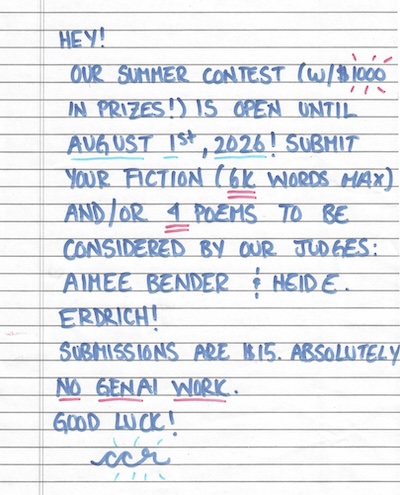
My friend Sophie is the managing editor for a literary magazine and this is what their call for submission looked like this past summer. I asked for permission to show this as an example because I found it so charming, and you can easily do this, too.
If you have any web properties you’re no longer updating, remove them
This isn’t about individual events and more about your online presence in general. If you have a website with a calendar or a Linktree with event listings and the most recent event there is six months ago, I will assume you’ve stopped hosting events. If I then see you posting new events on Instagram, I will be confused and upset.
If you no longer have the organizational capacity to maintain multiple sites of aggregation for your events, that’s entirely understandable! But then just take those venues down (or redirect people to your main contact point) so as not to accidentally mislead people into thinking you’re no longer active when you very much are.
Similarly, if you have a list of events on literally anything, please put upcoming events first.
Put the name of the city somewhere
This is mostly the internet’s fault, and I’m sorry, but social media is so wideranging and crosspollinating now that no matter how much I try to restrict my event sources to Toronto-only groups, I see events from all around the world. Do you know how many streets are named Queen or King in Canada alone? Please say somewhere in your description what city (at least!) the event is in.
If your event is virtual, this means putting the timezone on the event. Everyone knows timezones are the cities of the internet.
Put the year of the event somewhere
This is mostly Instagram’s fault, and I’m sorry, but Mister Zuckerberg’s Scape of Hell can and will serve up your events to people a year or two after they’ve taken place in a desperate bid for algorithmic engagement. Save yourself (and them) some pain by being clear about the year in the event.
Jenny it sounds like you mostly just hate Instagram
Dude I hate Instagram so much more than I even knew it was possible to and the myriad ways in which I think it is harmful for organizing is the subject of a whole other rant some other day. But above all, I believe in going to where people are instead of making them come to you, which is the spirit in which all of these demands exhortations pleas gentle suggestions are offered. I hope it is helpful, or at least mildly amusing.